Green Muze Interview (a) with John Dahlsen
John Dahlsen is a gifted and prolific environmental artist working with materials found on the beaches of his native Australia.
His diverse body of artwork includes stunning driftwood sculptures, totem poles made from beach reclaimed flip-flop shoes, discarded Coke bottles, ocean buoys and ocean reshaped plastic object assemblages, paintings and filmmaking.
His award winning, critically acclaimed art has been featured in numerous art shows, museums and galleries around the world. A regular on the international lecture and teaching circuit, Dahlsen has also organized environmental art shows around the globe, to further not only an appreciation of art but also to foster consideration for how we (mis)treat the environment.
We caught up with the extraordinary artist to ask a few questions about his evocative environmental artwork.
Please describe your artwork for us.
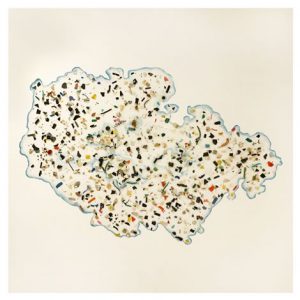
The central concerns of my work are with contemporary environmental art practice. I have for many years been working with found and recycled objects, most hand-picked by myself from somewhere along the Australian Coastline.
In fact it literally amazes me to think how many times I have bent over to pick up the many thousands of pieces of plastic debris that made up that aspect of my art, each piece jostled around for who knows how long by sand, sun and ocean, their form faded and rounded by the elements.
The unabated dumping of thousands of tons of plastics has been expressed in my assemblages, installations, totems, digital prints and public artworks.
And yet, despite my outrage at this environmental vandalism, I returned to the beach daily to find more pieces for my artist’s palette.
In an uncanny way, these plastics, as I sorted them and arranged them in my studio took on an unspeakable, indefinable and quite a magical beauty, which always fascinated me.
During the latter part of 2005 and into 2006, I created a new body of environmental artwork, a series of Synthetic Polymer paintings on Belgian linen, based on the subject matter of plastic “purges” – plastic fabricator machine end waste. ??This work, considers cycles and recycling. I began re-presenting paintings of sculptures that are inherently plastic fabricator machine end waste. The use of plastic materials and their place in the evolutionary motions of recycling are important to me in constructing these images.
I see the real need for the massive social transformations that are essential, to adequately deal with such crises as the depletion of fossil fuels and climate change. I hope this work can be a timely reminder to us all of the limited supply of these petroleum based materials, which is a direct result of our current collective global mass consumerism.